

























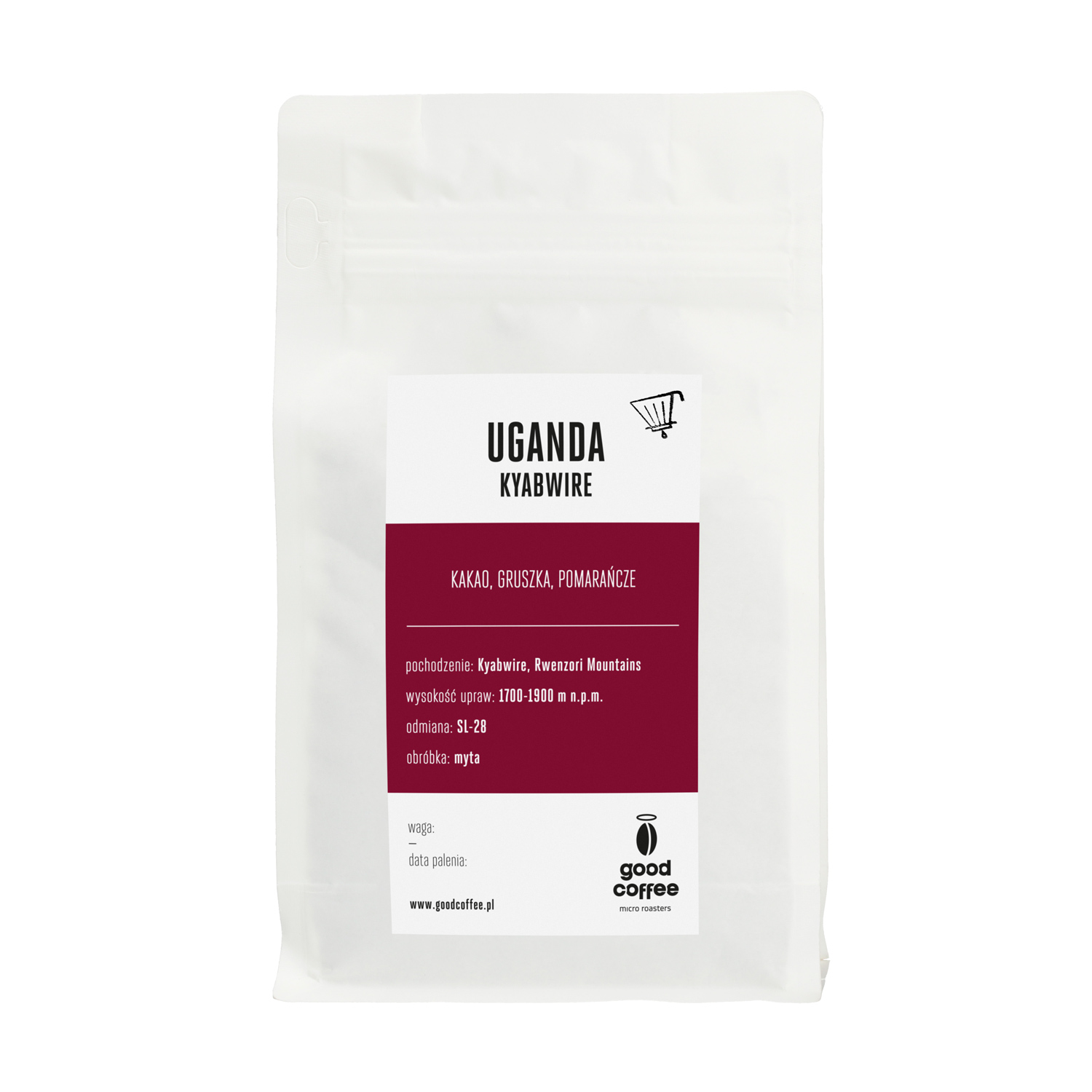
Good Coffee - Uganda Kyabwire Washed Filter 250 g
(TAX included)

Leave us your e-mail, we will let you know as soon as the selected product appears in the offer!

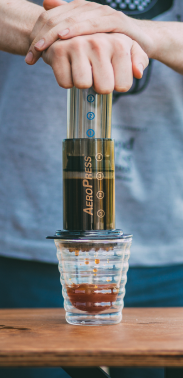
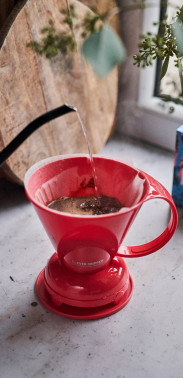
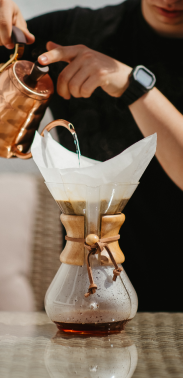
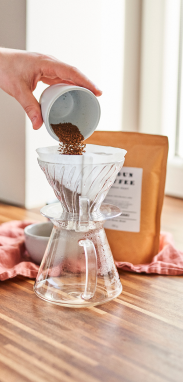
Whole-bean specialty coffee from Uganda, roasted by Good Coffee roasting brand. Light roast, perfect for filter coffee machines, drippers, Chemex, AeroPress, French Press, and other pour-over brewing methods. The brew resembles the flavour of cocoa, pear and orange.
Country: Uganda
Region: Fort Portal, Rwenzori Mountains
Altitude: 1700 - 1900 m a.s.l.
Processing: Washed
Variety: SL-28
ABOUT THE COFFEE
Coffee that makes a difference. Behind it are exceptional people. One of them—and we had the great pleasure of meeting him in person—is Kabuuka Elimethidas from the Empaako Collective. Kabuuka, known as Eli, is a young coffee farmer who, together with his wife Immaculate Karungi, dedicated himself to changing coffee trading conditions in western Uganda for the benefit of farmers.
ABOUT PRODUCTION
Eli grew up surrounded by coffee—his family cultivated robusta. He planted his very first coffee bush when he was 8 years old! After studying agronomy in Kampala, he took a job in the coffee industry in Fort Portal, western Uganda, where a local exporter hired him to liaise with farmers. The company collapsed right before the pandemic, leaving hundreds of farmers high and dry. Instead of looking for another job, Eli decided to help these producers sell their fruit. During that time, he witnessed many of the injustices that are still present in the coffee trade. What kind? For example, buyers would reject a reserved batch of cherries at the last minute without giving a reason—it is just like if you picked raspberries to sell, delivered them, and the buyer told you they would not buy them after all (fresh fruit, which coffee cherries are, spoils very quickly and cannot wait to be processed). Huge problems arose during peak harvest season, when buyers would slash purchasing prices to absurdly low levels or refuse to buy, claiming they already had too much fruit and could not process it (in a country where a farmer has a car and several buying stations nearby, this is no problem, but not in Uganda, where heavy bags of fruit are carried by hand—a working bicycle is the ultimate dream—and the next processing station is at least several dozen kilometers away). Unhonest middlemen were common, cheating farmers (e.g., with miscalibrated scales) or lending money to farmers to pay for school fees or food in exchange for a guaranteed low coffee price—so low that it did not cover production costs.
On top of that, producers lacked the resources and knowledge to properly manage their crops. Without fertilization, pruning, and weeding, the bushes bear less fruit, and many farmers do not know that they need to be replaced even every few years. Lacking this knowledge and the money for fertilizers or basic tools, many earned little more than 60 USD a year—despite immense manual labor from themselves and their entire families (!). It must be emphasized that these farmers were and are the most vulnerable part of the entire production chain, yet it is the most important part, without which the entire chain does not exist!
Eli saw a lot of this and dreamed of a system where farmers would be treated with respect and fairness. He thought about having his own buying and processing station where farmers could always sell their fruit and receive fair payment. He wanted to offer local producers predictable, dignified, and stable conditions.
Thanks to a coincidence, Eli and Immaculate met the company Semilla, and the dream came true—the Empaako Collective was born. Today, thanks to huge support from Semilla, Eli offers all producers the certainty that they will receive a fixed, guaranteed price for their fruit throughout the entire harvest season. For higher quality coffee, farmers receive higher pay, and the money goes directly into their hands as soon as the fruit is delivered to the buying station. Eli proudly showed us how he sent the day's payments using a special app! Interestingly, farmers receive the money on a mobile device and can exchange it for cash at any mobile phone kiosk, which are plentiful across East Africa (these are small shops where you can buy a SIM card, top up your phone, send a Western Union transfer, etc.). Eli and Immaculate also train farmers in cultivation and harvesting techniques, helping them achieve the best possible quality.
Our coffee consists of SL-28 variety beans coming from 11 farmers in the village of Kyabwire. After harvesting, the cherries are washed and sorted 3 times: first at the farmer's home, second at the buying station, and third at the processing station. Then, they are fermented in barrels for several dozen hours until they reach the correct pH level. Next, the skin and pulp are mechanically removed, and the beans are fermented again, then rinsed several times to remove the remaining parchment—the thin outer layer of the fruit on the beans. Finally, of course, they are dried on raised beds for about 3 weeks.
Store in a cool, dry place.
| Full product name (PL): | Good Coffee kawa ziarnista Uganda Kyabwire Washed Filter 250 g |
|---|---|
| Manufacturer: | GOOD COFFEE |
| Product type: | Coffee |
| Country of roasting: | Poland |
| Coffee bean origin: | Uganda |
| Acidity: | Medium |
| Arabica / Robusta (ratio): | 100% Arabica |
| Body: | Average |
| Brewing method: | Chemex, aeropress, drip coffee brewer, dripper, french press |
| Caffeine content: | Caffeinated |
| Coffee form: | Whole Bean |
| Growing location: | 1700-1900 |
| Growing region: | Kyabwire, Rwenzori Mountains |
| Processing: | Washed |
| Roast level: | Light |
| Specialty: | Yes |
| Sweetness: | Medium |
| Tasting notes: | chocolate, citrus fruits, green fruits |
| Tasting notes: | kakao, gruszka, pomarańcze |
| Variety: | SL28 |
| Index: | 2101015993 |
Whole-bean specialty coffee from Uganda, roasted by Good Coffee roasting brand. Light roast, perfect for filter coffee machines, drippers, Chemex, AeroPress, French Press, and other pour-over brewing methods. The brew resembles the flavour of cocoa, pear and orange.
Country: Uganda
Region: Fort Portal, Rwenzori Mountains
Altitude: 1700 - 1900 m a.s.l.
Processing: Washed
Variety: SL-28
ABOUT THE COFFEE
Coffee that makes a difference. Behind it are exceptional people. One of them—and we had the great pleasure of meeting him in person—is Kabuuka Elimethidas from the Empaako Collective. Kabuuka, known as Eli, is a young coffee farmer who, together with his wife Immaculate Karungi, dedicated himself to changing coffee trading conditions in western Uganda for the benefit of farmers.
ABOUT PRODUCTION
Eli grew up surrounded by coffee—his family cultivated robusta. He planted his very first coffee bush when he was 8 years old! After studying agronomy in Kampala, he took a job in the coffee industry in Fort Portal, western Uganda, where a local exporter hired him to liaise with farmers. The company collapsed right before the pandemic, leaving hundreds of farmers high and dry. Instead of looking for another job, Eli decided to help these producers sell their fruit. During that time, he witnessed many of the injustices that are still present in the coffee trade. What kind? For example, buyers would reject a reserved batch of cherries at the last minute without giving a reason—it is just like if you picked raspberries to sell, delivered them, and the buyer told you they would not buy them after all (fresh fruit, which coffee cherries are, spoils very quickly and cannot wait to be processed). Huge problems arose during peak harvest season, when buyers would slash purchasing prices to absurdly low levels or refuse to buy, claiming they already had too much fruit and could not process it (in a country where a farmer has a car and several buying stations nearby, this is no problem, but not in Uganda, where heavy bags of fruit are carried by hand—a working bicycle is the ultimate dream—and the next processing station is at least several dozen kilometers away). Unhonest middlemen were common, cheating farmers (e.g., with miscalibrated scales) or lending money to farmers to pay for school fees or food in exchange for a guaranteed low coffee price—so low that it did not cover production costs.
On top of that, producers lacked the resources and knowledge to properly manage their crops. Without fertilization, pruning, and weeding, the bushes bear less fruit, and many farmers do not know that they need to be replaced even every few years. Lacking this knowledge and the money for fertilizers or basic tools, many earned little more than 60 USD a year—despite immense manual labor from themselves and their entire families (!). It must be emphasized that these farmers were and are the most vulnerable part of the entire production chain, yet it is the most important part, without which the entire chain does not exist!
Eli saw a lot of this and dreamed of a system where farmers would be treated with respect and fairness. He thought about having his own buying and processing station where farmers could always sell their fruit and receive fair payment. He wanted to offer local producers predictable, dignified, and stable conditions.
Thanks to a coincidence, Eli and Immaculate met the company Semilla, and the dream came true—the Empaako Collective was born. Today, thanks to huge support from Semilla, Eli offers all producers the certainty that they will receive a fixed, guaranteed price for their fruit throughout the entire harvest season. For higher quality coffee, farmers receive higher pay, and the money goes directly into their hands as soon as the fruit is delivered to the buying station. Eli proudly showed us how he sent the day's payments using a special app! Interestingly, farmers receive the money on a mobile device and can exchange it for cash at any mobile phone kiosk, which are plentiful across East Africa (these are small shops where you can buy a SIM card, top up your phone, send a Western Union transfer, etc.). Eli and Immaculate also train farmers in cultivation and harvesting techniques, helping them achieve the best possible quality.
Our coffee consists of SL-28 variety beans coming from 11 farmers in the village of Kyabwire. After harvesting, the cherries are washed and sorted 3 times: first at the farmer's home, second at the buying station, and third at the processing station. Then, they are fermented in barrels for several dozen hours until they reach the correct pH level. Next, the skin and pulp are mechanically removed, and the beans are fermented again, then rinsed several times to remove the remaining parchment—the thin outer layer of the fruit on the beans. Finally, of course, they are dried on raised beds for about 3 weeks.
Store in a cool, dry place.
| Full product name (PL): | Good Coffee kawa ziarnista Uganda Kyabwire Washed Filter 250 g |
|---|---|
| Manufacturer: | GOOD COFFEE |
| Product type: | Coffee |
| Country of roasting: | Poland |
| Coffee bean origin: | Uganda |
| Acidity: | Medium |
| Arabica / Robusta (ratio): | 100% Arabica |
| Body: | Average |
| Brewing method: | Chemex, aeropress, drip coffee brewer, dripper, french press |
| Caffeine content: | Caffeinated |
| Coffee form: | Whole Bean |
| Growing location: | 1700-1900 |
| Growing region: | Kyabwire, Rwenzori Mountains |
| Processing: | Washed |
| Roast level: | Light |
| Specialty: | Yes |
| Sweetness: | Medium |
| Tasting notes: | chocolate, citrus fruits, green fruits |
| Tasting notes: | kakao, gruszka, pomarańcze |
| Variety: | SL28 |
| Index: | 2101015993 |