


















KitchenAid - Espresso Machine porcelain
(TAX included)


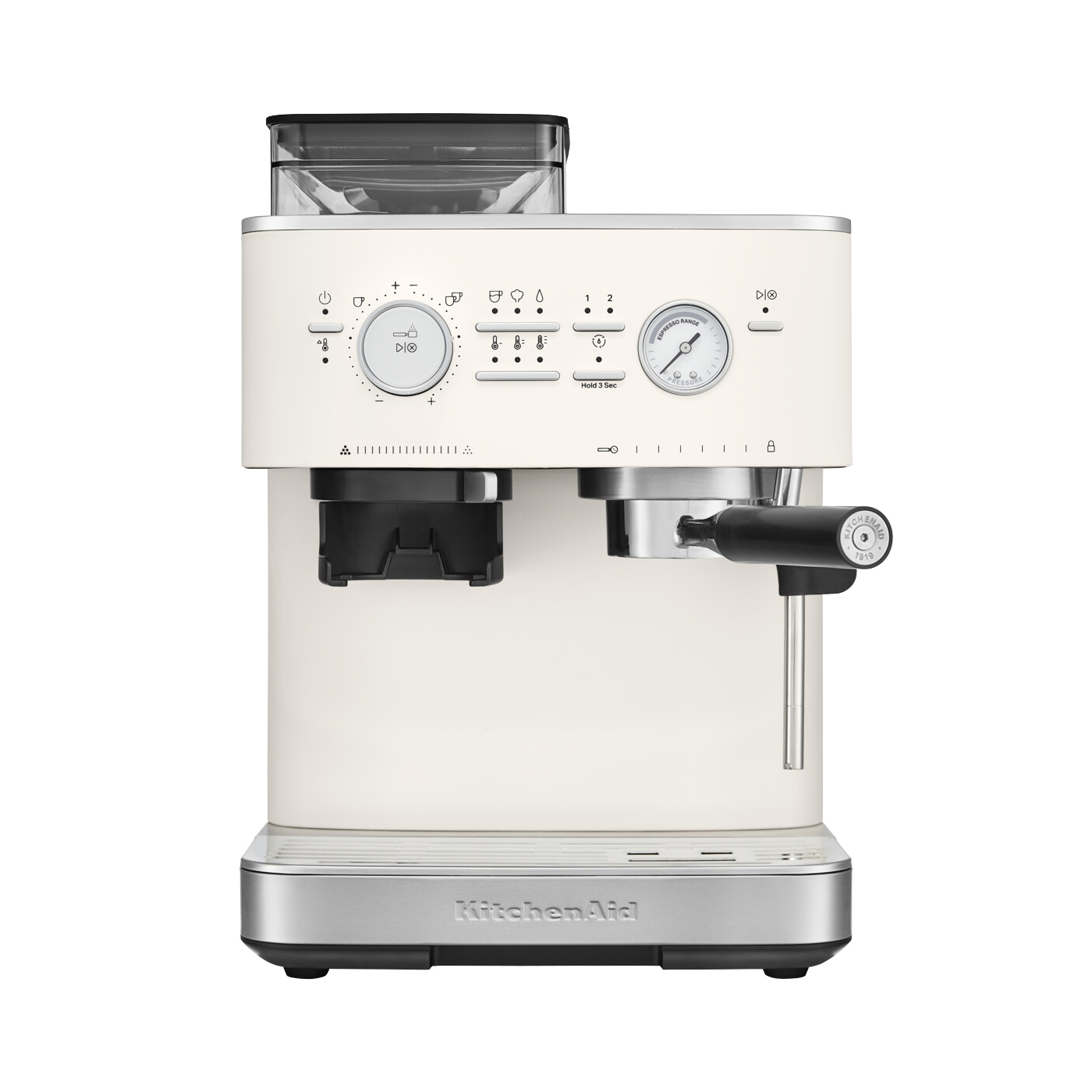
KitchenAid KES6551
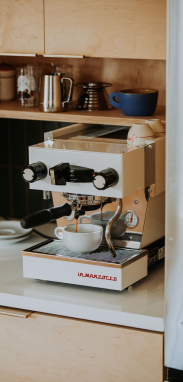
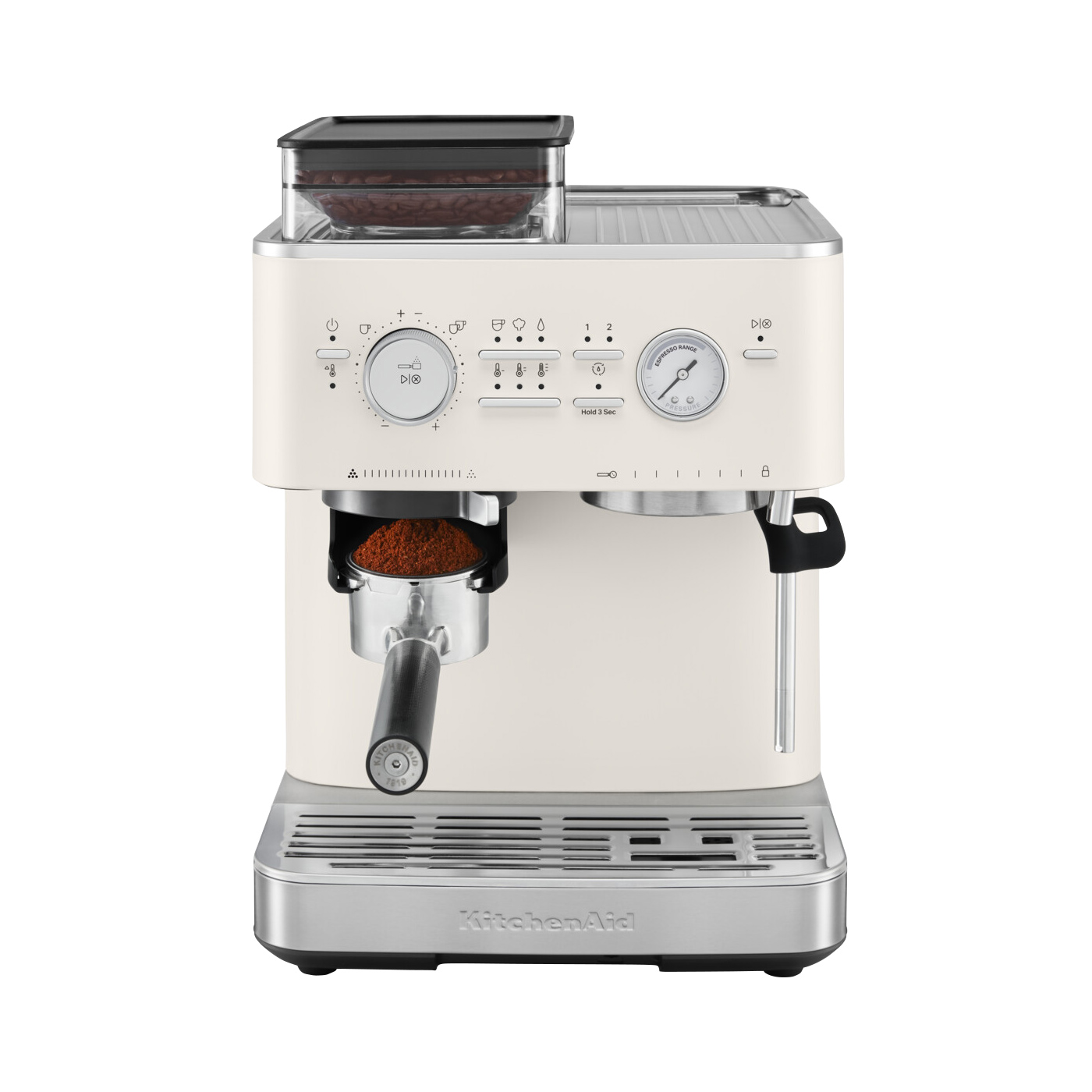
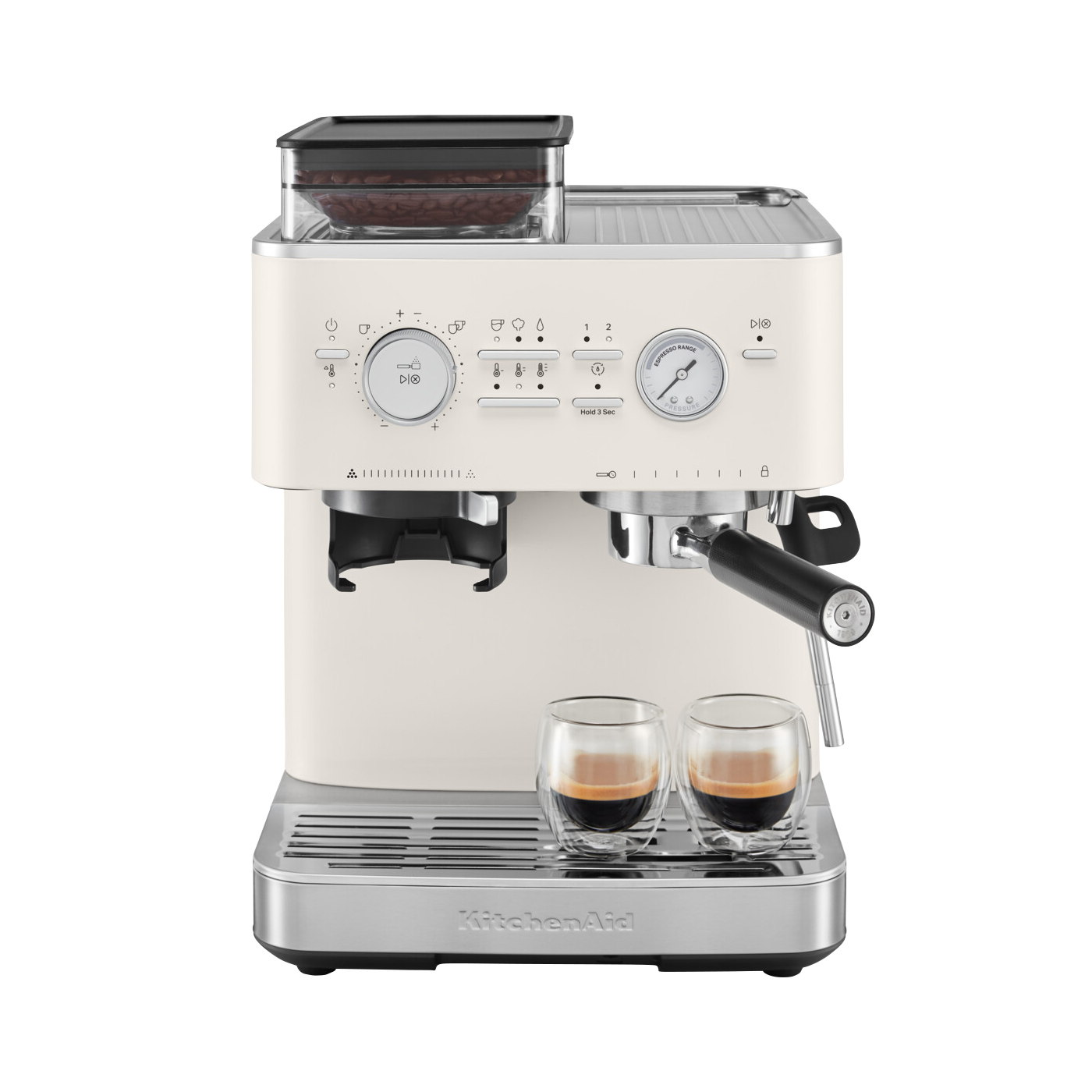
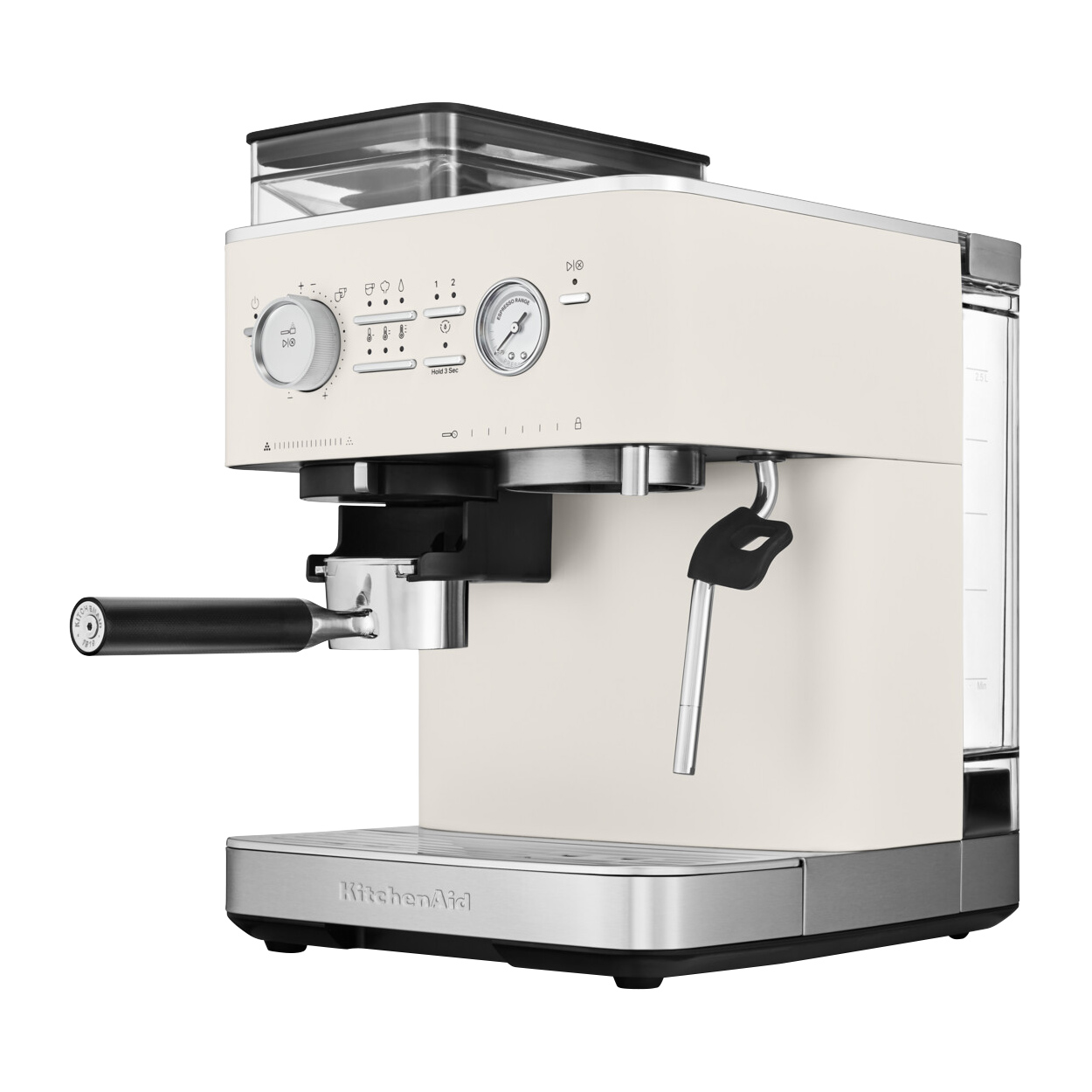
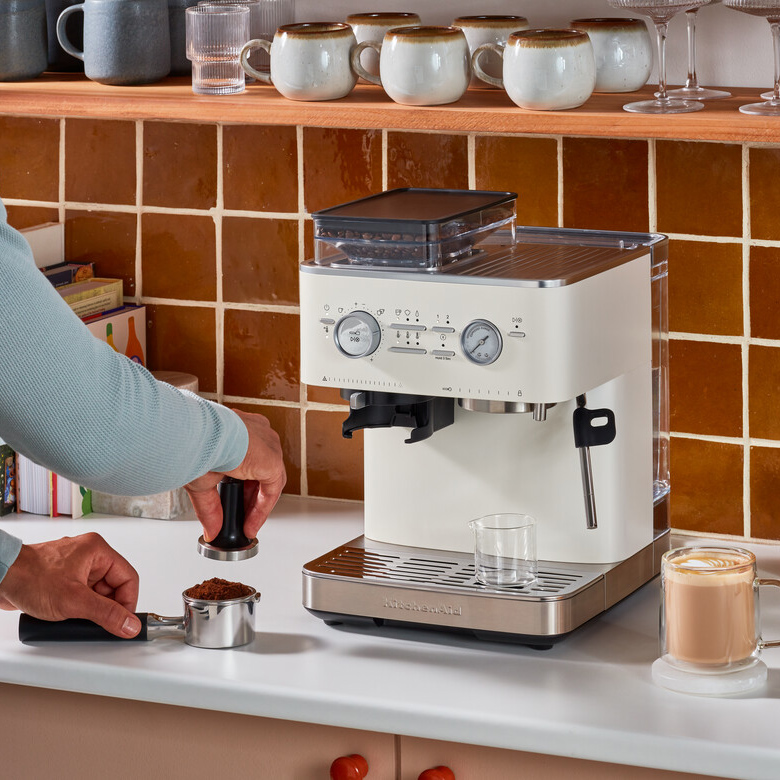
A morning on a portafilter machine looks different from a morning on a bean-to-cup: you lock the basket under the grinder, take the dose, tamp it and watch the espresso run into the cup. The KES6551 has the grinder on board, 15 grind settings and a micro-adjustment on the burrs, so there is plenty to dial in.
Add a 58 mm portafilter in the café standard, a multi-hole steam wand for milk and a 2.5 litre water tank. Quiet Mark certification means the grinding does not wake the whole house.
Who the KES6551 is for
This machine solves a few very specific situations:
- you want a say in how your espresso tastes: grind size, dose and tamp are yours to set, not the machine's
- you are moving from a bean-to-cup machine to a portafilter but do not want a separate grinder: this one is built in and grinds straight into the basket
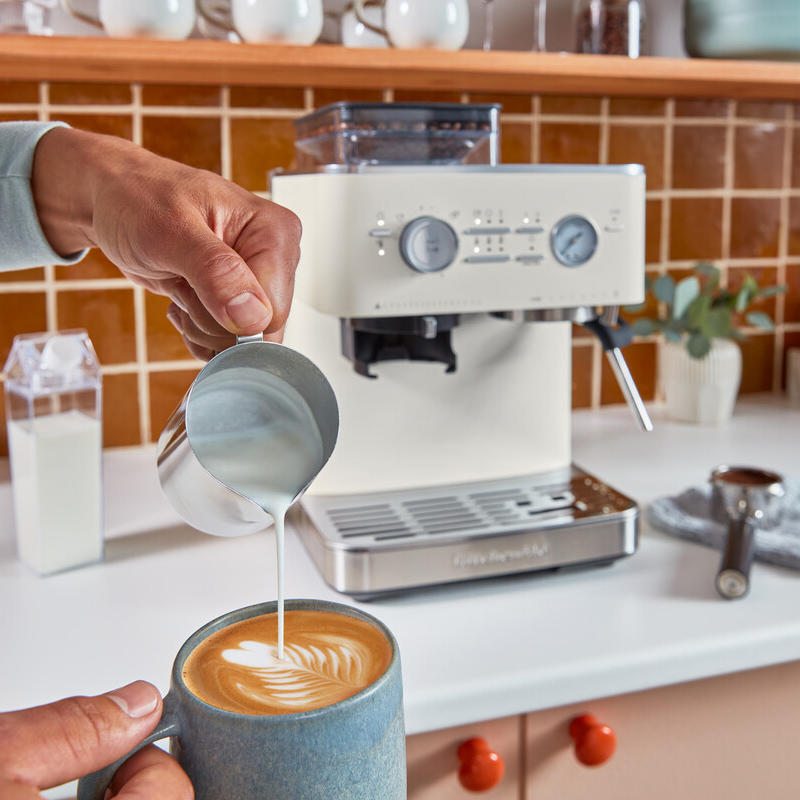
- you drink milk-based coffee and want to try latte art: the steam wand builds dense microfoam rather than a layer of bubbles
- you enjoy the ritual: on a portafilter machine you make the coffee rather than press a button
15 grind settings and a micro-adjustment
Grind size is the most important dial on any portafilter machine. The finer the grind, the slower water flows through the coffee and the stronger the espresso. Too fine and the drink turns bitter; too coarse and it runs thin.
The KES6551 gives you 15 steps on the dial. Those are the everyday ones: a step down when the shot runs too fast, a step up when it chokes in the portafilter.
Underneath sits a second layer: the upper burr has 7 micro-adjustment positions. They do not add further steps to the dial, they shift its whole range finer or coarser. You reach for them when the dial is at its limit and the coffee still is not running the way you want. With a light specialty roast that is sometimes the only route to a decent shot.
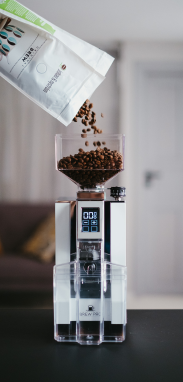
Fancy a different bean? Twist the hopper, lift it off, swap what is inside and go back to brewing. If you buy from several roasters, that is an everyday move rather than a monthly one.
Three steps to espresso
1. Grind into the basket. Lock the portafilter under the grinder and choose a dose for one or two shots.
2. Tamp the coffee. The flat base lets the portafilter sit steady on the worktop while you press with the tamper.
3. Brew and steam. Pre-infusion wets the puck before the shot, and the steam wand is ready for your milk jug.
A 58 mm portafilter and dosing that measures for you
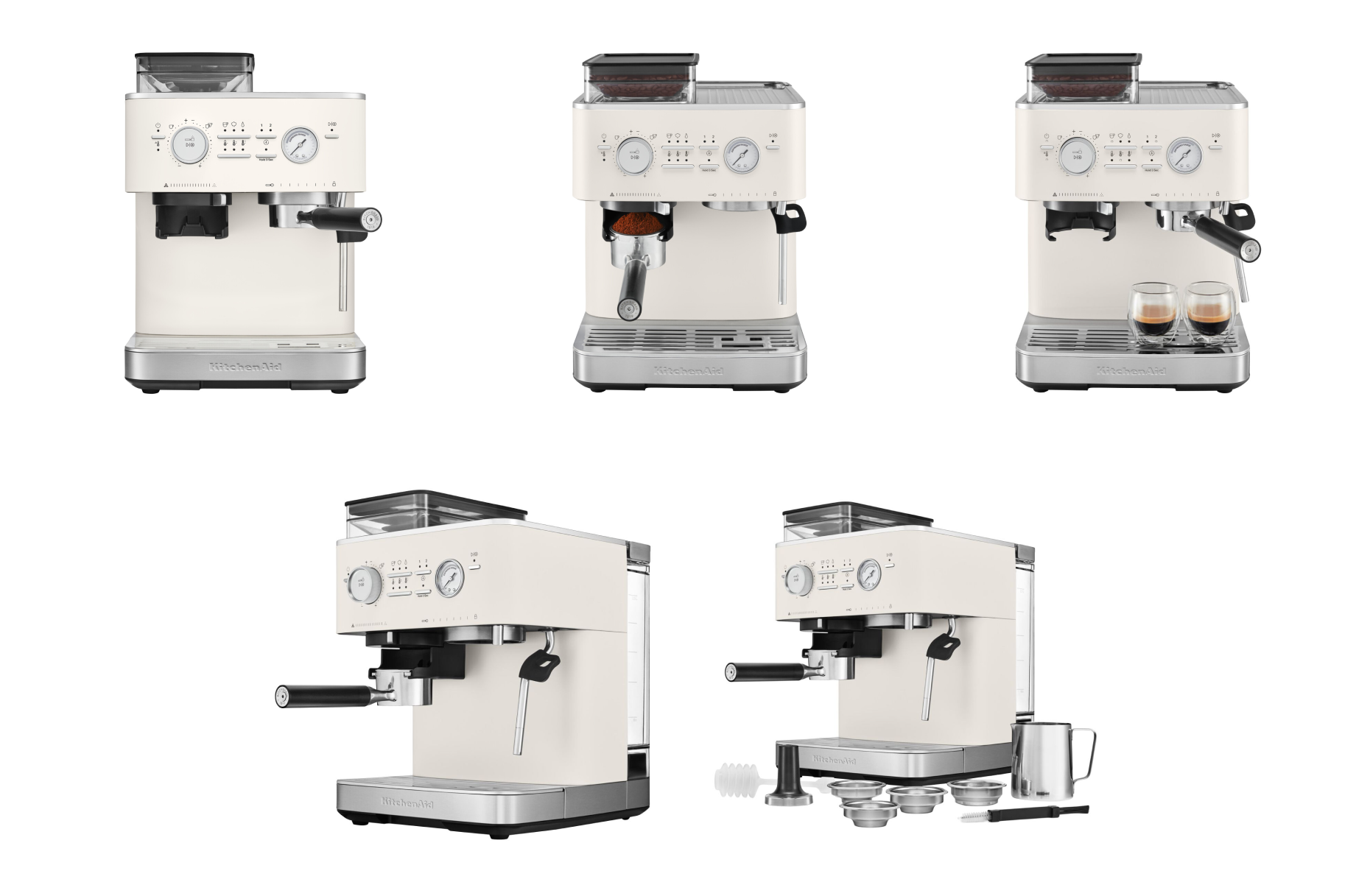
58 mm is the standard café size, so baskets, tampers and distributors from other brands will fit. The portafilter is stainless steel and its spouts are recessed into the body, so the whole thing sits flat on the worktop. You tamp on a steady base instead of holding the handle in mid-air the way classic designs make you.
Two kinds of basket come in the box. The double-wall one forgives an uneven tamp and a grind that is too coarse, so it earns its keep while you are learning. The single-wall one shows everything you do with the dose, the grind and the press, and that is the one to reach for once you want to dial a coffee in.
Grinding goes straight into the basket, and intelligent dosing measures a single or double shot at the press of a button. If you prefer weighing your coffee to the gram, top it up by hand and ignore the automation.
Pre-infusion and water ready on time
Pre-infusion is a short wetting of the ground coffee before the shot proper. The puck soaks evenly and water cannot find a shortcut through it, so the espresso comes out fuller and less often bitter on one side and sour on the other.
Water heats as it flows, without waiting for a boiler, and the tank holds 2.5 litres, roughly 33 shots per fill. With guests around you are not refilling at the tap after every coffee.
Milk and your first latte art
The multi-hole steam wand feeds steam into the milk through several jets at once, so the foam comes out dense and even rather than full of large bubbles. That texture is the prerequisite for drawing anything on a cappuccino.
A 355 ml jug is included, so the first attempts can happen the day it arrives. Steaming is manual: you guide the jug and decide when to stop. A leaf or a swan will come with practice, but dense milk for a cappuccino works from the start.
Everyday upkeep
- After every shot: knock out the puck and rinse the basket. Dried grounds leave a bitter note in the next cup.
- After every steaming: wipe the wand and purge it with steam. Milk dries inside the holes faster than you would think.
- Weekly: empty and rinse the water tank, wash the drip tray and the grounds container.
- When the machine asks: run the descaling programme. How often depends on how hard your water is.
- What not to do: never put anything but whole coffee beans in the grinder. Sugar-coated or flavoured beans can gum up the burrs.
Five terms worth knowing
The portafilter is the metal handle with a basket that holds the ground coffee and takes the pressurised water. Its size is given in millimetres and decides which accessories fit.
Tamping means pressing the coffee in the basket with a tamper. An evenly tamped puck offers water the same resistance across its whole surface, which is what makes extraction even.
Pre-infusion is the initial wetting of the coffee before the shot. The puck swells, so water cannot channel through its weakest points.
Single-wall and double-wall baskets differ in how much they forgive. The double-wall one has an extra plate that builds the pressure for you, so the espresso comes out with crema even when the grind is off. The single-wall one leaves the result entirely to your grind size, dose and tamp.
Quiet Mark is an independent certification linked to the British Noise Abatement Society, awarded after laboratory testing to the quietest 10 to 20 per cent of products in a given category. It comes without a decibel figure, because the same number sounds different from room to room.
Portafilter or bean-to-cup
KitchenAid offers both routes to espresso, and they differ not in quality but in how much you do yourself. On a KF bean-to-cup machine you press a button and take a finished drink. On the KES6551 you grind, tamp and steam the milk.
| Feature | KES6551 (portafilter) | KF bean-to-cup |
|---|---|---|
| Who brews | you: dose, tamp, timing | the machine, once you pick a drink |
| Grind size | 15 steps on the dial plus burr micro-adjustment | set automatically |
| Milk | manual, steam wand | automatic, depending on model |
| Time to a cup | longer, with a ritual | one button |
| Accessories | standard 58 mm fit | model-specific |
The KES6551 makes sense when you want a say in how your espresso tastes and treat brewing as part of the day rather than an obstacle before the first sip. If mornings are purely about speed, a KF bean-to-cup machine will get there faster and with less involvement.
Technical specification
| Model | 5KES6551 |
| Type | portafilter espresso machine with integrated grinder |
| Grinder | conical burrs |
| Grind settings | 15 steps on the dial |
| Burr micro-adjustment | 7 upper-burr positions, shifting the dial's range |
| Dosing | intelligent, single or double shot, with manual top-up |
| Portafilter | 58 mm, stainless steel, flat base |
| Baskets | single-wall and double-wall |
| Steam wand | multi-hole |
| Pre-infusion | yes |
| Water heating | Thermocoil |
| Pump pressure | 15 bar |
| Power | 1500 W |
| Water tank | 2.5 l, around 33 shots per fill |
| Bean hopper | 225 g |
| Auto shut-off | yes |
| Supply | 220–240 V, 50/60 Hz |
| Dimensions (W × H × D) | 335 × 395 × 281 mm |
| Net weight | 10.7 kg |
| Noise level | Quiet Mark certified |
| Guarantee | 36 months |
Frequently asked questions
Do I need a separate grinder?
No. A conical burr grinder is built in and grinds straight into the portafilter. That is the main difference from portafilter machines without a grinder, where a separate unit is essential.
Will accessories from other brands fit?
The portafilter is 58 mm, the size used in cafés, so tampers, baskets and distributors in that standard will fit. Just check that a basket is listed as 58 mm and whether it is single-wall or double-wall.
Why 15 grind settings and a micro-adjustment on top?
To dial espresso in to a particular coffee. Light specialty roasts usually need a finer grind than dark ones, and a single step can move a shot from sour to balanced. The burr micro-adjustment is the reserve for when the dial has run out of range and the shot is still too fast or too slow.
What does pre-infusion do?
Wetting the coffee first lets the puck soak evenly before the shot proper begins. The espresso comes out fuller and is less often bitter.
How much worktop will it take?
It measures 335 mm wide, 395 mm high and 281 mm deep. Check the clearance above it too, as the bean hopper fills from the top.
In the box
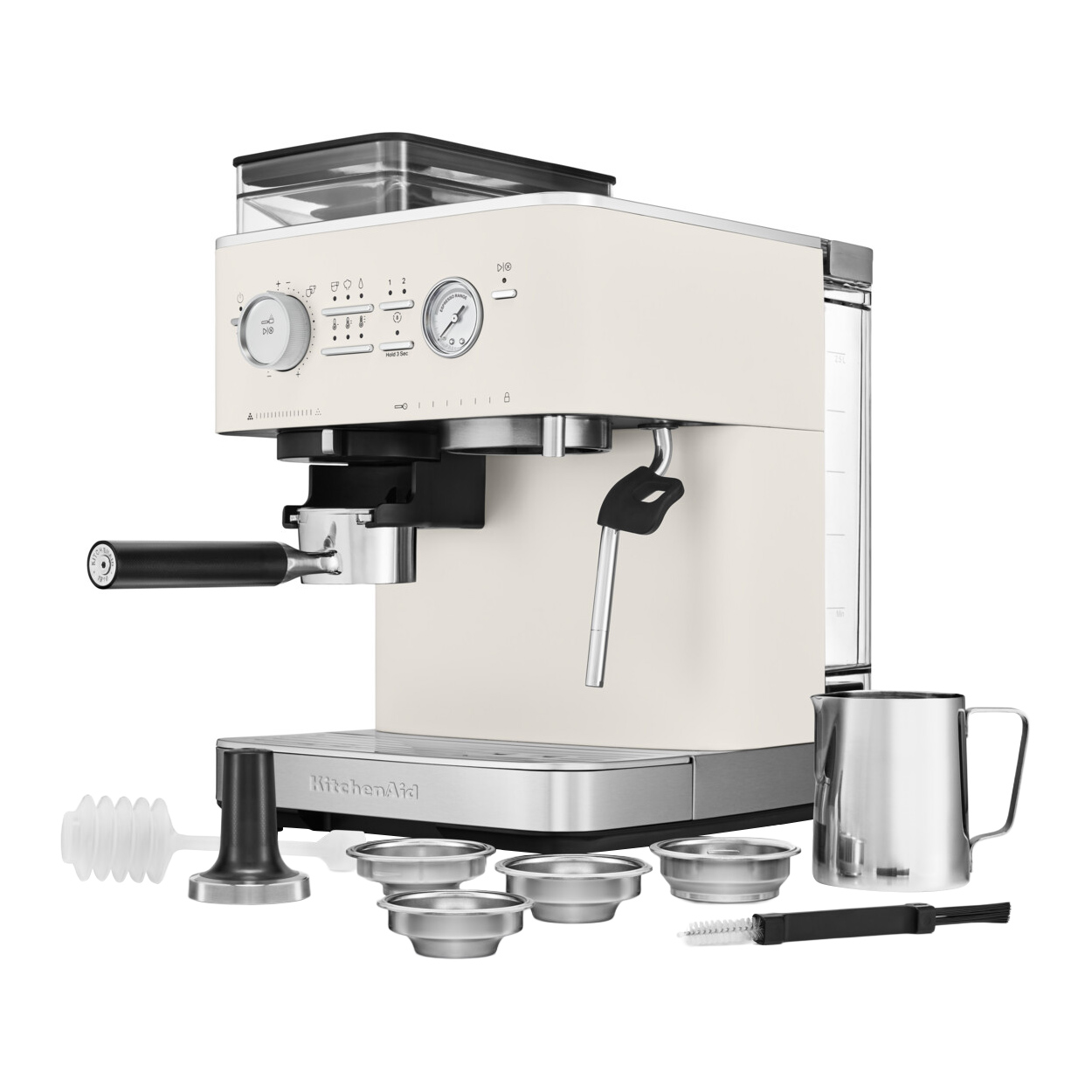
- Stainless steel portafilter with a flat base
- Single-wall portafilter baskets
- Double-wall portafilter baskets
- Stainless steel tamper
- 355 ml milk jug
- Cleaning brush
| Full product name (PL): | KitchenAid 5KES6551 Ekspres półautomatyczny porcelanowy |
|---|---|
| Product type: | Coffee Machines |
| Index: | 2601020080 |
| EAN: | 5413184802493 |
| Indeks zewnętrzny: | 5KES6551EPL |
| Manufacturer: |
KitchenAid Europa, Inc. Nijverheidslaan 3/box 5 1853 Strombeek-Bever Belgium |
| Manufacturer - Contact Point: |
VIVAMIX J.RADZIKOWSKI SPÓŁKA KOMANDYTOWA Mrówcza 208/ 04-697 Warszawa Polska |
KitchenAid KES6551
A morning on a portafilter machine looks different from a morning on a bean-to-cup: you lock the basket under the grinder, take the dose, tamp it and watch the espresso run into the cup. The KES6551 has the grinder on board, 15 grind settings and a micro-adjustment on the burrs, so there is plenty to dial in.
Add a 58 mm portafilter in the café standard, a multi-hole steam wand for milk and a 2.5 litre water tank. Quiet Mark certification means the grinding does not wake the whole house.
Who the KES6551 is for
This machine solves a few very specific situations:
- you want a say in how your espresso tastes: grind size, dose and tamp are yours to set, not the machine's
- you are moving from a bean-to-cup machine to a portafilter but do not want a separate grinder: this one is built in and grinds straight into the basket
- you drink milk-based coffee and want to try latte art: the steam wand builds dense microfoam rather than a layer of bubbles
- you enjoy the ritual: on a portafilter machine you make the coffee rather than press a button
15 grind settings and a micro-adjustment
Grind size is the most important dial on any portafilter machine. The finer the grind, the slower water flows through the coffee and the stronger the espresso. Too fine and the drink turns bitter; too coarse and it runs thin.
The KES6551 gives you 15 steps on the dial. Those are the everyday ones: a step down when the shot runs too fast, a step up when it chokes in the portafilter.
Underneath sits a second layer: the upper burr has 7 micro-adjustment positions. They do not add further steps to the dial, they shift its whole range finer or coarser. You reach for them when the dial is at its limit and the coffee still is not running the way you want. With a light specialty roast that is sometimes the only route to a decent shot.
Fancy a different bean? Twist the hopper, lift it off, swap what is inside and go back to brewing. If you buy from several roasters, that is an everyday move rather than a monthly one.
Three steps to espresso
1. Grind into the basket. Lock the portafilter under the grinder and choose a dose for one or two shots.
2. Tamp the coffee. The flat base lets the portafilter sit steady on the worktop while you press with the tamper.
3. Brew and steam. Pre-infusion wets the puck before the shot, and the steam wand is ready for your milk jug.
A 58 mm portafilter and dosing that measures for you
58 mm is the standard café size, so baskets, tampers and distributors from other brands will fit. The portafilter is stainless steel and its spouts are recessed into the body, so the whole thing sits flat on the worktop. You tamp on a steady base instead of holding the handle in mid-air the way classic designs make you.
Two kinds of basket come in the box. The double-wall one forgives an uneven tamp and a grind that is too coarse, so it earns its keep while you are learning. The single-wall one shows everything you do with the dose, the grind and the press, and that is the one to reach for once you want to dial a coffee in.
Grinding goes straight into the basket, and intelligent dosing measures a single or double shot at the press of a button. If you prefer weighing your coffee to the gram, top it up by hand and ignore the automation.
Pre-infusion and water ready on time
Pre-infusion is a short wetting of the ground coffee before the shot proper. The puck soaks evenly and water cannot find a shortcut through it, so the espresso comes out fuller and less often bitter on one side and sour on the other.
Water heats as it flows, without waiting for a boiler, and the tank holds 2.5 litres, roughly 33 shots per fill. With guests around you are not refilling at the tap after every coffee.
Milk and your first latte art
The multi-hole steam wand feeds steam into the milk through several jets at once, so the foam comes out dense and even rather than full of large bubbles. That texture is the prerequisite for drawing anything on a cappuccino.
A 355 ml jug is included, so the first attempts can happen the day it arrives. Steaming is manual: you guide the jug and decide when to stop. A leaf or a swan will come with practice, but dense milk for a cappuccino works from the start.
Everyday upkeep
- After every shot: knock out the puck and rinse the basket. Dried grounds leave a bitter note in the next cup.
- After every steaming: wipe the wand and purge it with steam. Milk dries inside the holes faster than you would think.
- Weekly: empty and rinse the water tank, wash the drip tray and the grounds container.
- When the machine asks: run the descaling programme. How often depends on how hard your water is.
- What not to do: never put anything but whole coffee beans in the grinder. Sugar-coated or flavoured beans can gum up the burrs.
Five terms worth knowing
The portafilter is the metal handle with a basket that holds the ground coffee and takes the pressurised water. Its size is given in millimetres and decides which accessories fit.
Tamping means pressing the coffee in the basket with a tamper. An evenly tamped puck offers water the same resistance across its whole surface, which is what makes extraction even.
Pre-infusion is the initial wetting of the coffee before the shot. The puck swells, so water cannot channel through its weakest points.
Single-wall and double-wall baskets differ in how much they forgive. The double-wall one has an extra plate that builds the pressure for you, so the espresso comes out with crema even when the grind is off. The single-wall one leaves the result entirely to your grind size, dose and tamp.
Quiet Mark is an independent certification linked to the British Noise Abatement Society, awarded after laboratory testing to the quietest 10 to 20 per cent of products in a given category. It comes without a decibel figure, because the same number sounds different from room to room.
Portafilter or bean-to-cup
KitchenAid offers both routes to espresso, and they differ not in quality but in how much you do yourself. On a KF bean-to-cup machine you press a button and take a finished drink. On the KES6551 you grind, tamp and steam the milk.
| Feature | KES6551 (portafilter) | KF bean-to-cup |
|---|---|---|
| Who brews | you: dose, tamp, timing | the machine, once you pick a drink |
| Grind size | 15 steps on the dial plus burr micro-adjustment | set automatically |
| Milk | manual, steam wand | automatic, depending on model |
| Time to a cup | longer, with a ritual | one button |
| Accessories | standard 58 mm fit | model-specific |
The KES6551 makes sense when you want a say in how your espresso tastes and treat brewing as part of the day rather than an obstacle before the first sip. If mornings are purely about speed, a KF bean-to-cup machine will get there faster and with less involvement.
Technical specification
| Model | 5KES6551 |
| Type | portafilter espresso machine with integrated grinder |
| Grinder | conical burrs |
| Grind settings | 15 steps on the dial |
| Burr micro-adjustment | 7 upper-burr positions, shifting the dial's range |
| Dosing | intelligent, single or double shot, with manual top-up |
| Portafilter | 58 mm, stainless steel, flat base |
| Baskets | single-wall and double-wall |
| Steam wand | multi-hole |
| Pre-infusion | yes |
| Water heating | Thermocoil |
| Pump pressure | 15 bar |
| Power | 1500 W |
| Water tank | 2.5 l, around 33 shots per fill |
| Bean hopper | 225 g |
| Auto shut-off | yes |
| Supply | 220–240 V, 50/60 Hz |
| Dimensions (W × H × D) | 335 × 395 × 281 mm |
| Net weight | 10.7 kg |
| Noise level | Quiet Mark certified |
| Guarantee | 36 months |
Frequently asked questions
Do I need a separate grinder?
No. A conical burr grinder is built in and grinds straight into the portafilter. That is the main difference from portafilter machines without a grinder, where a separate unit is essential.
Will accessories from other brands fit?
The portafilter is 58 mm, the size used in cafés, so tampers, baskets and distributors in that standard will fit. Just check that a basket is listed as 58 mm and whether it is single-wall or double-wall.
Why 15 grind settings and a micro-adjustment on top?
To dial espresso in to a particular coffee. Light specialty roasts usually need a finer grind than dark ones, and a single step can move a shot from sour to balanced. The burr micro-adjustment is the reserve for when the dial has run out of range and the shot is still too fast or too slow.
What does pre-infusion do?
Wetting the coffee first lets the puck soak evenly before the shot proper begins. The espresso comes out fuller and is less often bitter.
How much worktop will it take?
It measures 335 mm wide, 395 mm high and 281 mm deep. Check the clearance above it too, as the bean hopper fills from the top.
In the box
- Stainless steel portafilter with a flat base
- Single-wall portafilter baskets
- Double-wall portafilter baskets
- Stainless steel tamper
- 355 ml milk jug
- Cleaning brush
| Full product name (PL): | KitchenAid 5KES6551 Ekspres półautomatyczny porcelanowy |
|---|---|
| Product type: | Coffee Machines |
| Index: | 2601020080 |
| EAN: | 5413184802493 |
| Indeks zewnętrzny: | 5KES6551EPL |
| Manufacturer: |
KitchenAid Europa, Inc. Nijverheidslaan 3/box 5 1853 Strombeek-Bever Belgium |
| Manufacturer - Contact Point: |
VIVAMIX J.RADZIKOWSKI SPÓŁKA KOMANDYTOWA Mrówcza 208/ 04-697 Warszawa Polska |